Have you ever started a new habit with SO much motivation, only for it to fizzle out a couple of weeks later?
Well, you’re not alone. Most of us have been there!
Lately I’ve been reading Atomic Habits by James Clear, and honestly, it’s helping me every single day. The book’s big idea is that small habits, repeated every day, add up to big results, and that good systems keep you going on the days motivation doesn’t show up.
That fits planning perfectly. So in this post I’ll share the Atomic Habits ideas that I think work best in a planner, and how to put each one into practice with the pages in your digital planner.
In short
- Atomic Habits by James Clear is about tiny habits that add up over time, and systems that make good habits easier to keep.
- Habit stacking: link a new habit to one you already do, and write the pair in your routine planner.
- Two-minute rule: shrink a new habit until it’s easy to start, like one line in your daily check-in.
- Track it, and never miss twice. Tick off habits on your habit tracker and get back on track the very next day.
What is Atomic Habits about?
Atomic Habits is a book by James Clear about how habits work, and how to build good ones (and break bad ones) without relying on willpower. An “atomic” habit is a tiny one. It’s small and easy to do, but it’s part of something much bigger.
A few of the book’s big ideas:
- Small improvements, repeated every day, add up to big changes over time.
- Your systems matter more than your goals.
- Lasting habits start with the kind of person you want to become.
- To build a good habit, make it obvious, attractive, easy and satisfying.
It’s an easy read with lots of practical examples, and I’d recommend it if you haven’t read it yet. Below, I’ve put each of these ideas into my own words, along with the planner pages that go with it.
Small habits add up, so track them
One of the book’s biggest ideas is that tiny improvements compound. Getting a little bit better each day doesn’t feel like much on its own, but over a year it adds up to a LOT.
The catch is that you can’t see that progress day to day, which is why so many of us give up too early.
That’s where a habit tracker comes in. Mine is a Habits + Trackers page for each month, with a row for each habit and a box for every day. If your planner doesn’t have one, a simple grid on a notes page works just as well.
As the boxes fill up, you can actually SEE your progress. Watching a row of ticks grow is surprisingly motivating, and you won’t want to break the streak.
Set up systems to reach your goals
This one is close to my heart, because “decide on your goals and set up systems to reach them” is pretty much my favorite piece of advice.
James Clear points out that people who succeed and people who don’t often have the very same goals. The difference is in their systems, the small things they do again and again.
In your planner, it can look like this.
- The goal goes in the My Goals section, with your “why” written next to it.
- The system goes on your weekly schedule and routine planner, as small actions with a day and a time.
- The check happens on your weekly check-in, where you note what went well and what didn’t.
Need help with the goal part? My post on how to set goals you will actually achieve walks you through it, and how to plan your week in a digital planner covers the weekly system.
Start with who you want to become
Another big idea in the book is identity-based habits. Rather than focusing on what you want to achieve (“I want to read more”), you focus on who you want to become (“I’m a reader”).
Every time you do the habit, it’s like casting a small vote for that kind of person. Read one page? That’s a vote for being a reader.
Two planner pages work really well for this:
- The Best Version of Myself page in the wellness section, a lovely spot to describe the person you’re becoming.
- Today’s affirmation at the top of your daily check-in. Write your identity as an affirmation, like “I am someone who looks after my health.” Need ideas? Here are 25 daily affirmations to start with.
The four laws of behavior change, planner style
James Clear sums up habit building in four simple laws. To build a good habit, make it obvious, make it attractive, make it easy and make it satisfying. Here’s how each one looks in a digital planner.
Make it obvious with habit stacking
Habit stacking means linking a new habit to something you already do every day. After I do this, I’ll do that. For example, “After I pour my morning coffee, I’ll open my daily check-in.”
The routine planner is perfect for this. It has tables for your morning, evening and night routines, with a time next to each step and a tick box for every day of the week. Write the habit you already have, then the new habit straight underneath it, so the new one always has a clear cue.
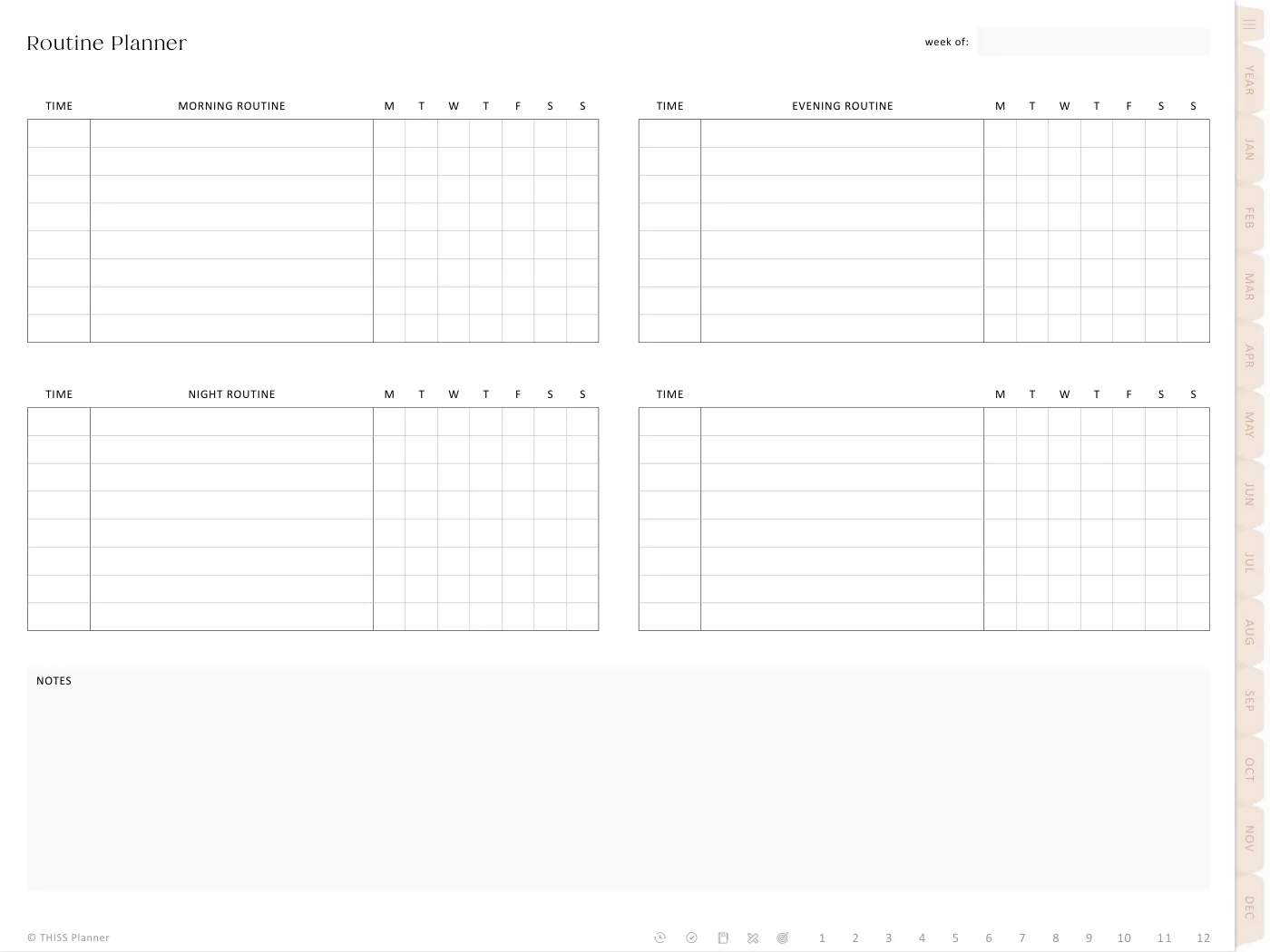
Your weekly schedule helps here too. Instead of “exercise more,” write “walk at 7am” in Tuesday’s time slot. The book calls this an implementation intention, which is really just a fancy name for time blocking.
Make it attractive
We’re much more likely to stick with habits we enjoy. One idea from the book is to pair something you need to do with something you love, like doing your weekly planning with a cup of tea and your favorite playlist.
And yes, a planner you love looking at counts too! Pick a cover and tab color that makes you happy, so opening your planner feels like a little treat.
Make it easy with the two-minute rule
The two-minute rule says that when you start a new habit, shrink it down until it takes two minutes or less. “Read every night” becomes “read one page.” “Journal every day” becomes “write one line.”
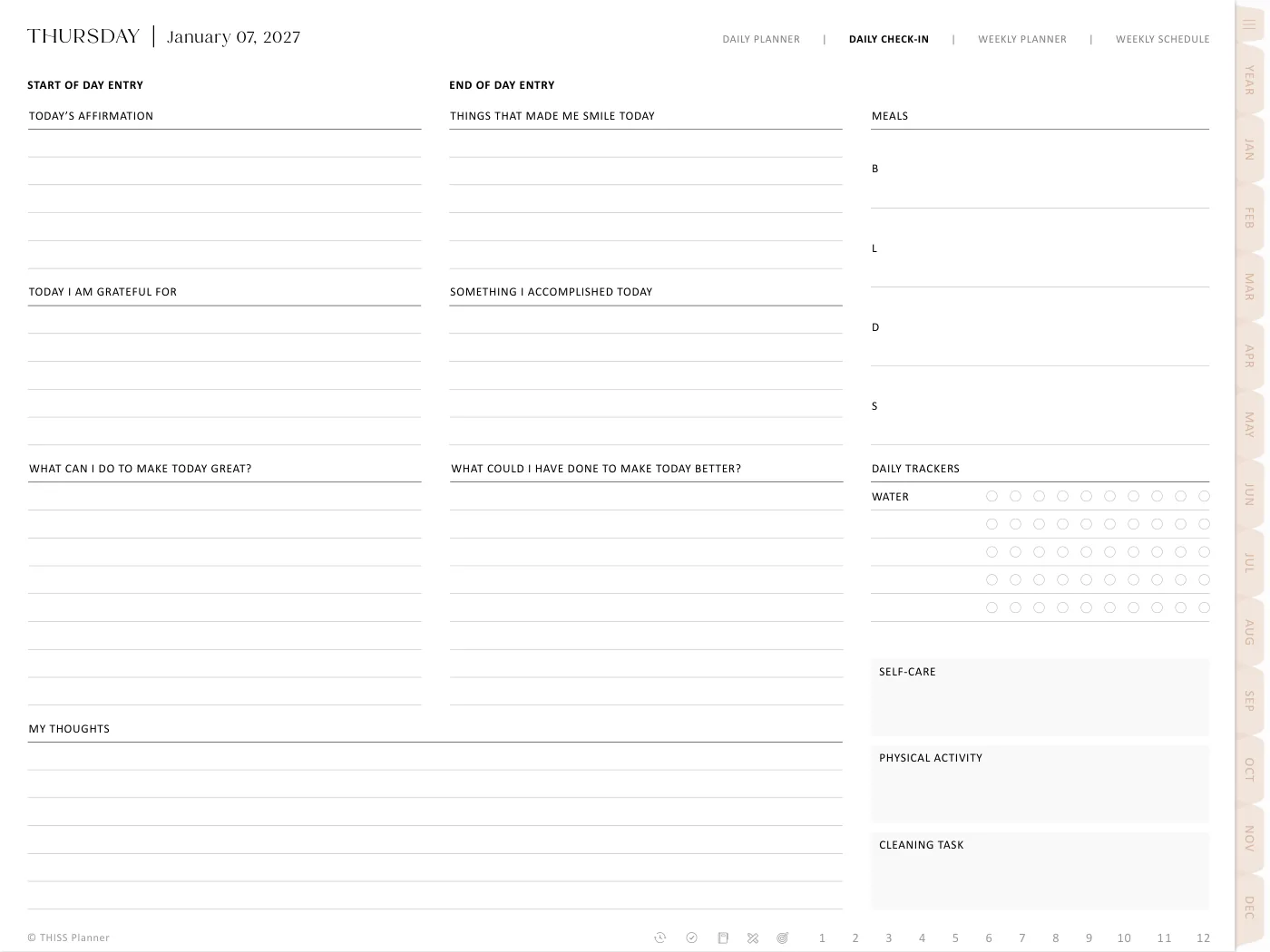
Your daily check-in is made for this. You don’t have to fill in the whole page. Write today’s affirmation, or one thing you’re grateful for, and that’s your habit done for the day. Once it feels automatic, add a little more.
Make the planner itself easy to reach, too. A widget or Home Screen icon puts it one tap away. Here’s how to set that up.
Make it satisfying
We repeat what feels good. And there’s something SO satisfying about ticking a box!
Tick off each habit on your Habits + Trackers page, fill in the circles in the habits section of your weekly check-in, or pop a sticker on a day you showed up. Use the same sticker for the same habit each time, and a quick glance at your month shows how often it happens.
Never miss twice
This idea really takes the pressure off. Missing one day doesn’t undo your progress. Life happens! The trouble starts when one missed day turns into two, then a whole week.
James Clear’s answer is to never miss twice. If you spot an empty box on your habit tracker, make that habit a top priority on tomorrow’s daily page.
Then use “What didn’t go so well?” on your weekly check-in to work out why. Was the habit too big? Was the time wrong? Tweak it for next week. Your monthly reflection page is great for a bigger review, with space for what you’ll start, continue and stop doing.
Common questions
Do I need to read Atomic Habits to use these ideas?
No, but I’d recommend it. This post only covers a few of the book’s ideas, in my own words. The book goes into much more detail, with lots of examples.
Which planner pages are best for building habits?
Start with three: a monthly habit tracker, a routine page and a short daily check-in. That’s plenty! You can always add more once those feel easy.
How many habits should I start with?
Just one or two. It’s tempting to add ten new habits on January 1, but a couple of small ones you actually keep will do much more for you.
Small steps, every day
What I love about Atomic Habits is how doable it feels. Pick one small habit, give it a cue and tick a box when it’s done. Then do it again tomorrow.
If you haven’t read the book yet, I really do recommend it. And if you have, I hope this gives you a few ideas for putting it into practice in your planner!
Keep reading: How to set goals you will actually achieve, 25 daily affirmations that will improve your life and How to stick with your digital planner all year.